Cardiac apprehension does not feel abstract when it takes place in front of you. It resembles a colleague dropping over a desk, or a grandparent going silent during supper, or a complete stranger at the fitness center that all of a sudden quits relocating. In those moments, help shows up in mins if you call for it, yet a brain can endure irreparable damage in 4 to 6 mins without oxygen. The interval between collapse and the first breast compression is where common people make the difference. That is the heart of community security, and it is why CPR training belongs in the very same category as discovering to drive or swim.
I have instructed first aid and CPR for several years to instructors, tradies, parents, safety team, and secondary school trainees. The pattern corresponds. People get here assuming CPR training is a box to tick, then leave understanding it as a life ability that rewires how they notice threat, exactly how they make decisions under stress, and how they show up for others. The advantages run deeper than a certificate for your purse. They alter a neighbourhood's odds.

What CPR Actually Does, and Why Seconds Trump Everything
CPR, or cardiopulmonary resuscitation, is not concerning "restarting the heart" with your hands. It is a means to keep blood transferring to the mind and crucial organs when the heart has stopped pumping effectively, usually as a result of an unexpected cardiac arrest. Good breast compressions create a portion of typical blood flow, but that fraction suffices to acquire time until a defibrillator can remedy a shockable rhythm or sophisticated treatment can take over.
The mathematics that underpins necessity is basic and grim. For each min without CPR, the chance of survival from cardiac arrest come by approximately 7 to 10 percent. If a bystander begins CPR within the initial min or more, survival prices can increase and even three-way contrasted to situations without early activity. These are big swings driven by little selections: progression, call for help, begin compressions, ask somebody to bring the AED.
I have actually seen family members freeze while a teenager from a lifeguard course took cost and led reliable compressions. Training does not make you courageous. It gives you a manuscript your body can comply with when your mind is buzzing.
The Real-World Forming of an Onlooker Rescue
If you have not taken a cpr course, it is simple to picture chaos. In method, a well-taught cpr training course breaks the minute into a series you can hold.
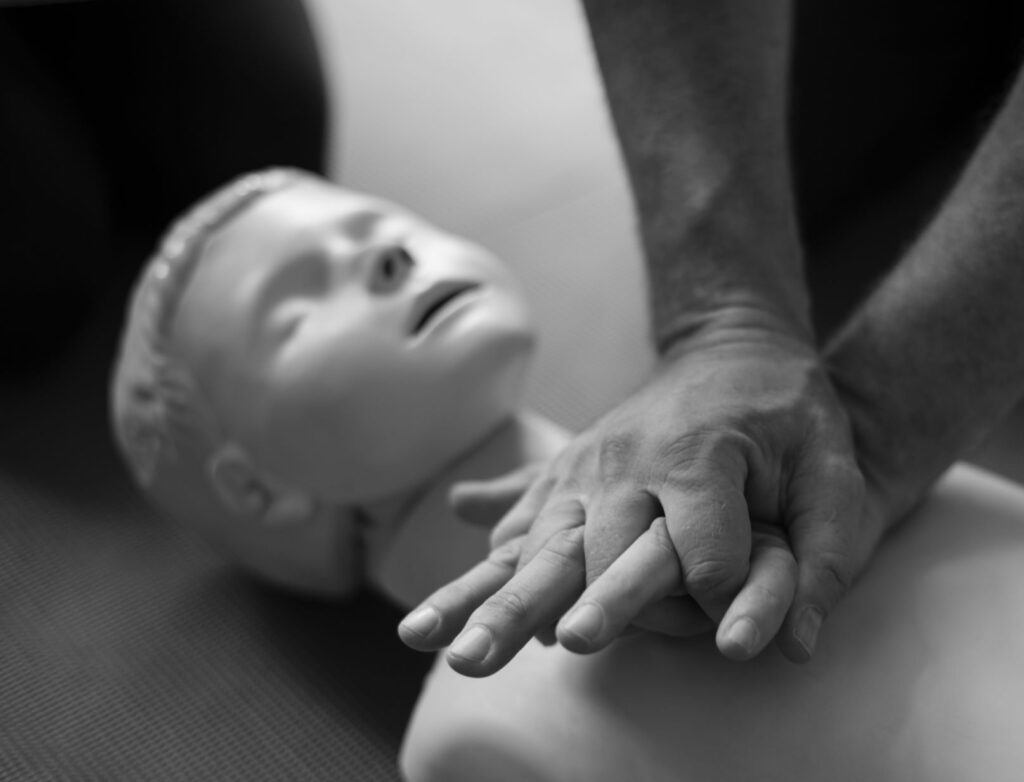
You check for responsiveness. You yell for aid. You call emergency situation solutions on audio speaker so the driver can instructor and record the address while you remain with the individual. If there is no normal breathing, you start upper body compressions at a depth of about 5 to six centimeters for an adult, at a rhythm near to the beat of "Stayin' Alive." If an AED shows up, you turn it on, put the pads as illustrated, and adhere to the triggers. The tool analyzes the rhythm and tells you whether to press the shock button. You return to compressions quickly after.
I have actually seen this readjusted on the fly in a childcare setting with a kid, and in a carpark with a male two times my dimension. Technique varies with age and physique, yet the foundation of activity continues to be: push hard, push quick, enable complete upper body recoil, minimize stops, and make use of the AED swiftly.
The Ripple Effects of Training Beyond Heart Arrest
When people sign up in a first aid course, they often anticipate bandages and recuperation settings. They entrust a larger lens. First aid and cpr training improves threat recognition, communication abilities, and team sychronisation. You end up being the individual that notifications the choking risk at a barbeque and cuts grapes lengthwise for toddlers. You find out to check for a departure path at congested locations, not from paranoia however from habit.
In offices, this attitude lowers not just the severity of events, but their regularity. A storage facility that trains and rejuvenates its initial aiders normally tightens its housekeeping, identifies its chemical shops clearly, and places automated external defibrillators where they can be located without a scavenger hunt. Individuals take breaks when they should. They report near misses. Safety becomes cultural, not performative.
Training additionally improves myths. I still meet grownups that believe you need to put something in the mouth of an individual having a seizure. You should not. Or that you can "feel" a faint pulse under anxiety. Numerous can not. Standard first aid and cpr courses fix these behaviors delicately, and change them with reputable abilities you can use under pressure.
A Short Story From a Supermarket Aisle
Several years earlier, a colleague of mine was shopping when a guy broken down near the fruit and vegetables section. He explained the checkout line going silent, after that the spread audio of people yelling for water, which never aids. He actioned in, identified himself as first aid trained, checked for breathing, and started compressions on a slick floor tile floor.
A store worker arrived with an AED from the wall surface alongside the staff space. It was messy, which informed us nobody had actually touched it in months. Still, it powered on. The device suggested a shock. They got rid of and pressed the switch, then returned to compressions. The rescue arrived after the 2nd shock. The man lived.
What maintained that male active was not luck. It was the junction of three common decisions: the grocery store had set up an AED, my associate had actually taken a cpr course the previous spring, and an onlooker had the clearheadedness to call emergency solutions loudly and clearly. Community safety and security is constructed out of these small, uninteresting investments.
What an Excellent CPR Course In Fact Teaches
There is a difference in between checking out a poster and exercising on a manikin up until your arms shake. Evidence-based training strings the line in between realistic look and security. A reliable cpr course need to consist of the following:
- Hands-on compressions with responses on deepness and price, preferably utilizing manikins that gauge efficiency and provide real-time cues. AED use from start to finish, including pad placement on grownups and youngsters, voice motivates, shock delivery, and risk-free resumption of compressions. Airway skills appropriate to the degree of training, from head-tilt chin-lift to pocket mask use, and guidance on when to include rescue breaths. Scenarios that build decision-making: single rescuer in a tight room, team effort across a loud environment, care of a casualty with presumed spinal injury. Safety, hygiene, and consent, consisting of how to protect on your own from biohazards and how to value social borders while offering lifesaving care.
Those five components allow people to progression without improvising method on the most awful day of a person's life. They also develop a typical language, so you and a stranger can work with without friction.
Where First Aid and CPR Fit Together
Pure cpr training is focused and fast, which suits teams that need a slim skill set. Many companies, however, select a more comprehensive first aid and cpr course that covers extra ground in a single session. The hybrid strategy makes good sense for colleges, gyms, community centers, and building and construction websites. You cover CPR and AED usage, however additionally bleeding control, burns, choking, allergic reactions, diabetic emergencies, asthma action plans, and workplace-specific risks.
The extra time repays in circumstances that are not promptly harmful however can wear away if ignored. I think of the pupil that recognized anaphylaxis at smoko due to the fact that he had actually found out the early indicators, administered an auto-injector, and kept an eye on breathing while awaiting paramedics. That outcome hinges on first aid training that expands beyond compressions.
If you are stabilizing time and budget plan, pair a much shorter cpr course with accessible microlearning refresher courses, or pick a complete first aid and cpr course every two or three years with set up practice in between. Specifications can differ by nation and industry, so examine neighborhood advice when choosing what mix of training your group needs.
The Situation for Refresher courses: Skills Fade, Self-confidence Faster
Skill degeneration in CPR is not a character flaw. It is biology and memory. Researches show measurable decrease in compression top quality and AED sequence recall within months after training, especially if you have actually not utilized the skills. Confidence often declines also quicker than proficiency, which suggests people wait longer, or defer to others.
That is why a cpr correspondence course is not a high-end for nit-pickers. It is a maintenance routine for skills you hope you never require. Short, concentrated refresher courses can be as brief as 90 mins and provide an out of proportion advantage. You recalibrate your compression depth, you rehearse pad positioning, you keep in mind to switch over compressors every two mins to stay clear of fatigue, and you adapt to any type of modifications in guidelines.
I have enjoyed whole staffs improve in a single afternoon due to the fact cpr course Epping that they exercised with metronome apps, revolved functions purposely, and connected the training to their actual layout. Refresher courses transform knowledge into muscular tissue memory.
Why the Certification Matters, and Why It Does Not
A first aid certificate does 2 points. It indicates to employers and regulatory authorities that you have met a standard, which can be vital for insurance policy and conformity. It likewise first aid and cpr course Mandurah offers cpr training Mandurah you a timestamp, a suggestion that abilities age and will certainly need an additional look.
What it does refrain is make you immune to adrenaline. Despite a new certificate, your hands may drink throughout a genuine event. That is normal. The measure that counts is not flawless implementation, yet prompt, reliable activity. An excellent service provider writes training courses that approve human limitations and build redundancy. You might begin compressions slightly off facility, after that self-correct after the initial cycle. You may screw up an AED pad, after that recoup. The person on the ground does not need perfection. They need oxygen moving.
Choosing a Training Service provider Without Regret
The training market is crowded, and quality arrays widely. You desire a supplier that premises their first aid courses in existing guidelines, invests in ample tools, and instructs in ways that acknowledge real-life restraints. If a program commits most of the day to glide decks and sends 20 trainees to a single manikin, that is a red flag.
Ask concerning trainer experience, not just certifications. Trainers that have worked in field settings, whether as paramedics, registered nurses, lifeguards, or event paramedics, have a tendency to appear edge situations that make the material stick. They can discuss, for example, just how to do compressions on a soft bed mattress using a backboard, or exactly how to take care of privacy and authorization in a crowded workplace. A supplier like First Aid Pro, or any type of reputable regional organization with a strong track record, ought to be able to outline exactly how they update training courses when worldwide resuscitation councils change their guidelines.
Finally, search for alternatives that match your individuals. Evening classes for hospitality staff. Onsite training for construction crews. Blended knowing where concept is online and the sensible is in person. The most effective training course is the one your group completes with attention and retains with pride.
The Psychology of Tipping Forward
Most onlookers do not act because they are afraid doing injury or being condemned. These anxieties are easy to understand, however they do not show what we understand. In several jurisdictions, Good Samaritan protections exist for individuals who provide help in good belief. More notably, the threat of passivity exceeds the threat of incomplete activity in heart attack. Chest compressions on a person whose heart is beating are awkward however seldom dangerous. Doing nothing while the mind deprives is catastrophic.
Training changes psychology by giving people a psychological map. In course, you practice stating, "You, in the blue shirt, call three-way zero and bring back an AED," also if there is no blue t-shirt. That practiced assertiveness matters. I as soon as taught a team of educators who moaned at the role-playing, then two months later made use of precisely that phrasing to coordinate an action to a choking event in the cafeteria. Method does not just develop your hands. It lends your voice authority.
Technology Assists, People Save
AEDs are smarter, lighter, and much easier to utilize than they were a years back. Some have pediatric settings constructed into the same unit. Many supply metronome hints for compression rhythm and train you through the process with clear voice triggers. Smart device integration can crowdsource close-by -responders in some cities, alerting experienced volunteers when there is a believed heart attack within a few blocks.
Even with much better equipment, the human factor stays crucial. An AED in a secured workplace may as well get on the moon. A volunteer network is only as solid as the people who maintain their cpr abilities fresh. Proprietors must examine AED battery and pad expiry days, message clear signs, and run short drills to make sure that employees can get and deploy the device without hunting for keys or guessing a code. Innovation reduces the path to a shock, yet just if people maintain the path clear.
Special Contexts: Children, Professional Athletes, and Rural Settings
CPR on babies and youngsters needs modifications. You utilize 1 or 2 hands for a child, 2 fingers for a baby, and you alter your compression deepness and price accordingly. Many first aid and cpr courses include these variants because moms and dads, teachers, and coaches request them. The risks feel greater with youngsters, and the concern of doing harm can ice up individuals. Educating sculpts that fear down to dimension with repetition.
Athletic atmospheres position a different dynamic. Unexpected heart attack in sport is uncommon, but when it occurs, it takes place in public with lots of observers. Groups that run preseason cpr training for coaching staff, situate AEDs at areas, and establish a basic emergency plan shave crucial mins. I have actually seen clubs transform a chaotic scene into a coordinated initiative because they place an AED case on the outside of a clubhouse and walked teens with how to use it.
Rural and remote communities face the lengthiest rescue reaction times. That space makes local capability even more beneficial. A community hall with an AED, a few homeowners who have completed a cpr course, and a phone tree for emergency situations can alter end results substantially. In those setups, first aid training commonly includes improvisation: using things at hand for cushioning, taking care of hypothermia in winter months rescue scenarios, or passing on directions to -responders over uneven mobile service.
How to Build a Culture, Not a Checkbox
If you want CPR literacy to stick, connect it to identification. A coffee shop that celebrates its baristas for finishing cpr training and articles a tiny sign near the till will certainly trigger conversations and remind personnel they become part of a safeguard. A school that weaves first aid into health and wellness education and learning, after that does short refresher courses for educators each term, constructs continuity. A construction company that includes a cpr correspondence course in its seasonal start-up meetings makes it clear these abilities matter as high as difficult hats.
It likewise assists to reduce rubbing. Pre-schedule courses and refreshers. Deal choices in language and timing. Offer light treats. Put AED areas on workplace maps. Keep first aid kits stocked and noticeable, and select somebody to own that job. These are little functional choices that transform intent into habit.
The Quiet Benefit: Self-confidence and Neighborhood Cohesion
The most regular feedback I hear after a first aid and cpr course is relief. Not blowing, not swagger, just the silent knowledge that if something takes place, you are not helpless. That sensation surges with homes and teams. Parents sleep a little simpler with a brand-new infant in the house. Supervisors stress much less when an employee returns from cardiac surgery. Colleagues on a Saturday league area care for each other with more care.
It additionally changes how we deal with strangers. The presence of a bystander who visibly recognizes what to do can steady a group, punctured noise, and prevent additional harm. Individuals quit filming on their phones and begin helping. A person gets a covering. A person clears area. Somebody satisfies the rescue at the door. These are not remarkable acts, however they are the material of a safer community.
Getting Started Today
If you have never educated, or it has been years since your last class, select a reliable service provider and book a day. A certified first aid course that consists of CPR will participate of a day and will provide you both skills and a first aid certificate that lots of work environments identify. If your time is tight, start with a devoted cpr course and schedule a more comprehensive first aid and cpr course later on in the year.
For teams, set up onsite training so individuals discover in the area where they will certainly act. Walk through where the AED rests, who has tricks, just how to direct paramedics to the back door, and where lights is poor during the night. Construct a brief checklist for new hires that consists of AED area and emergency situation get in touches with, appropriate along with payroll forms.
If you are already trained, plan your following cpr refresher course now, not after one more year slips by. Put a reminder in your calendar six months before your certification expires. Practice compressions at home on a cushion while you watch a short, reliable video. Freshen your memory about when to change functions, how to utilize pediatric pads, and what to do if a person is damp or resting on a conductive surface.
A Final Word From the Training Floor
I keep in mind a session with a team of hospitality employees where one individual, a silent server in her twenties, kept doubting her strength. On the third round of compressions, the feedback tool lit eco-friendly. She searched for, stunned, then smiled. Months later, she emailed to state she had assisted at a bus quit when a male broke down. She did precisely what she had exercised, and by the time paramedics arrived, she was hoarse and worn down. The guy lived.
That story is not uncommon. The outcome is never assured, however the opportunity you offer a person can be the difference that matters to a family members, to a group, to a street of next-door neighbors. Community safety and security is not a program that federal governments provide to us. It is a stance we take on and a skill set we maintain.

Take the program. Practice. Program others. Location the AED where anybody can reach it. If you ever before need it, you will be grateful you made time. If you never ever do, you will certainly have reinforced the net around everybody you care about.